
Language Selector
Secure Checkout

Visible MgF2 Antireflection Coated Achromatic Doublet Lenses
Visible MgF2 Antireflection Coated Achromatic Doublet Lenses

Our visible MgF2 coated achromatic doublet lenses feature minimized spherical aberration and coma at infinite conjugates, yielding minimal focus spot size. Unlike singlet lenses, achromatics have constant focal length independent of aperture and operating wavelength, and have superior off-axis performance.
- 400-700 nm Single-layer visible MgF2 AR coating
- Significantly better optical performance than singlet lenses
- Nearly constant focal length across the visible spectrum
- Far superior off-axis performance
- Diameters and focal lengths interchange with our singlet lenses
- Ideal for general purpose benchtop prototyping
- Nearly constant focal length across the visible spectrum See All Features
| Compare | Description | Drawings, CAD & Specs | Avail. | Price | ||
|---|---|---|---|---|---|---|
 | PAC010Achromatic Doublet Lens, Visible, 6.35 mm, 12.7 mm EFL, 400-700 nm | In Stock | ||||
| PAC013Achromatic Doublet Lens, Visible, 6.35 mm, 19.0 mm EFL, 400-700 nm | |||||
| PAC016Achromatic Doublet Lens, Visible, 6.35 mm, 25.4 mm EFL, 400-700 nm | |||||
 | PAC019Achromatic Doublet Lens, Visible, 12.7 mm, 19.0 mm EFL, 400-700 nm | In Stock | ||||
| PAC022Achromatic Doublet Lens, Visible, 12.7 mm, 25.4 mm EFL, 400-700 nm | In Stock | ||||
| PAC024Achromatic Doublet Lens, Visible, 12.7 mm, 31.8 mm EFL, 400-700 nm | In Stock | ||||
| PAC025Achromatic Doublet Lens, Visible, 12.7 mm, 38.1 mm EFL, 400-700 nm | In Stock | ||||
| PAC028Achromatic Doublet Lens, Visible, 12.7 mm, 50.8 mm EFL, 400-700 nm | In Stock | ||||
| PAC031Achromatic Doublet Lens, Visible, 12.7 mm, 63.5 mm EFL, 400-700 nm | In Stock | ||||
| PAC034Achromatic Doublet Lens, Visible, 12.7 mm, 76.2 mm EFL, 400-700 nm | In Stock |
Mounting Options
We offer a full range of optical lens mounts to meet various experimental requirements. Below lists the recommended mounts for spherical lenses of standard sizes. Please see our Lens Mount Guide for additional information.
Note: besides the diameter, please check the Edge Thickness (Te) specification of the lens and the lens mount to ensure compatibility before purchasing.
| Lens Diameter | 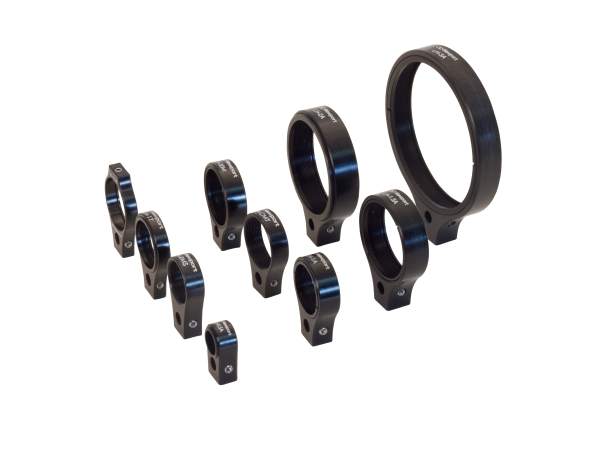 A-Line™ Lens Mounts |
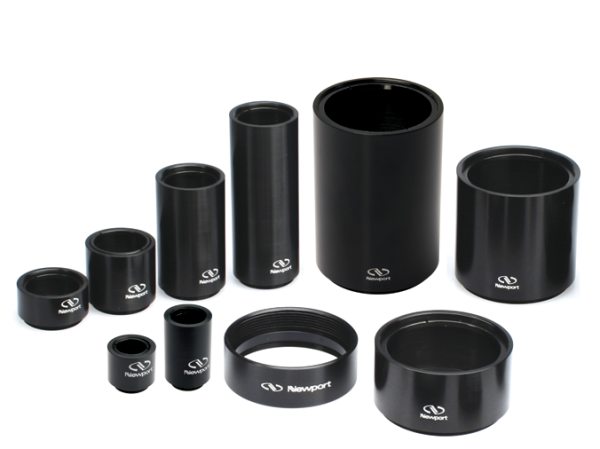 LT Series Lens Tubes |
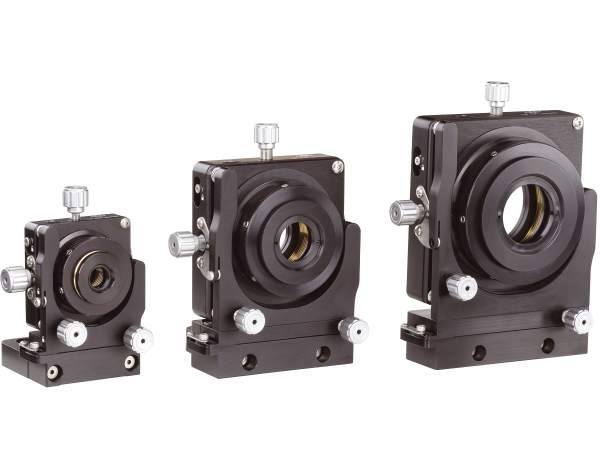 LP Series Lens Positioners |
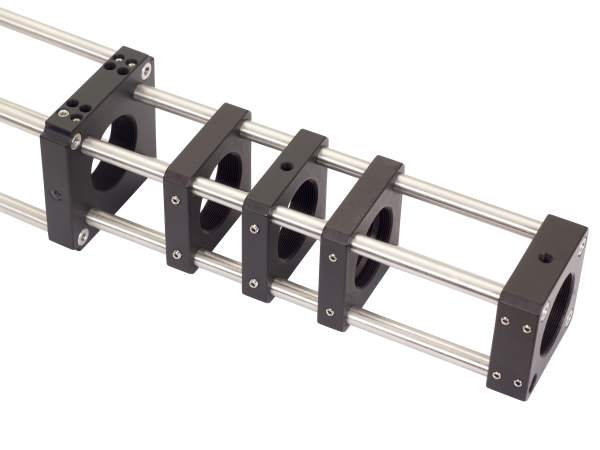 Optics Cage Plus Series |
|---|---|---|---|---|
| 76.2 mm | ( |
N/A | N/A | N/A |
| 50.8 mm | ( |
N/A | ||
| 38.1 mm | ( |
LT20 lens tube with |
LP-2 lens positioner with |
N/A |
| 25.4 mm | ( |
|||
| 12.7 mm | ( |
N/A | ||
| 6.35 mm | LT05 lens tube with |
LP-05 lens positioner with |
N/A |
For non-standard sizes not listed above, check out our variable size lens mounts.
Specifications
- Lens TypeAchromatic Doublet
- Antireflection Coating400-700 nm
- Coating TypeVisible Single-Layer MgF2
- Damage Threshold1.0 J/cm2 @ 1064 nm, 10 ns , 10 Hz
- TransmissionT>95%
- Surface Quality40-20 scratch-dig
- OrientationSteepest convex surface should face the infinite conjugate
- Design Wavelengths486.1, 546.1, 656.3 nm
- Centration≤3 arc min
- Diameter Tolerance+0/-0.1 mm
- Focal Length Tolerance±2.0%
Features
Achromatic Lenses
An Achromat, or Achromatic lens, is usually made up of multiple optical elements, which can be air-spaced or cemented together. These typically alternate a positive lens of low index material, such as crown glass, and a negative lens of high index material, such as flint glass. The elements are selected and optimized so that dispersion in the positive element is corrected by the negative element, resulting in minimized chromatic aberration at two well-separated wavelengths. Achromats offer a nearly constant focal length across the visible spectrum, providing superior off-axis performance. Doublet lenses offer users many more design options than singlet lenses, which allows for superior performance in visual imaging and laser beam manipulation applications. Our lenses are computer designed, minimizing aberrations and providing a smaller focused spot size. They are offered with multi-layer or single-layer AR coatings. Standard diameters and focal lengths may be interchanged with our singlet lenses. Further, achromats are available in a wide variety of configurations, including positive, negative, triplet, and aspherized. These lenses are produced as doublets or triplets (three elements). The collimated beam should enter or depart from the surface (R1 in drawing) with higher curvature (smaller radius) for optimized performance.
MgF2 Visible Antireflection Coating
Our single layer Magnesium Fluoride visible AR coating is the most common choice that offers extremely broad wavelength range at a reasonable price. It is standard on achromats and optional on our N-BK7 plano-convex spherical lenses and cylindrical lenses. Comparing to the uncoated surface, the MgF2 provides a significant improvement by reducing the reflectance to less than 1.5%. It works extremely well over a wide range of wavelengths (400 nm to 700 nm) at angles of incidence less than 15 degrees.

Superior Performance in Monochromatic Applications
Achromats are superior to singlet lenses for monochromatic applications at any visible wavelength. Negative achromatic lenses are used primarily to extend focal lengths, which is often combined with positive achromatic mirror systems and imaging lenses. Generally a diffraction limited spot may be achieved when using a monochromatic source such as laser.
IR Performance
Visible achromats are still usable in the IR, although they are not optimized. An achromat will not be diffraction limited at 1064 nm but performance will still be superior to a singlet lens. At 1064 nm, the focal length of a typical achromat increases by approximately 0.75%. Choosing these optics for image relay or optical processing applications will be more desirable than single element lenses.
Design Wavelengths
Newport's visible achromatic doublet lenses are design around the following visible wavelengths 486.1, 546.1, and 656.3 nm.


