
Vat Polymerization Additive Manufacturing
Often referred to as 3D printing, additive manufacturing (AM) is a fundamentally different approach to traditional industrial manufacturing. It is often thought of as a technique to make complex or lower volume products such as prototypes, concepts and custom one-off parts. But as product complexity increases, AM methods become less costly compared to traditional manufacturing (machining) methods. As such, AM is already used prevalently for production in several industries including aerospace, automotive, healthcare and energy. Demand for AM is predicted to increase further as software, computing power, materials and methods improve over time.In response, engineers will design considerably more products specifically for AM methods, including products too complex for traditional manufacturing to produce. In time, AM may be able to provide what today is thought of as a contradiction: off-the-shelf customization.
Updated: 6/15/2026
A Future of Off-The-Shelf Customization
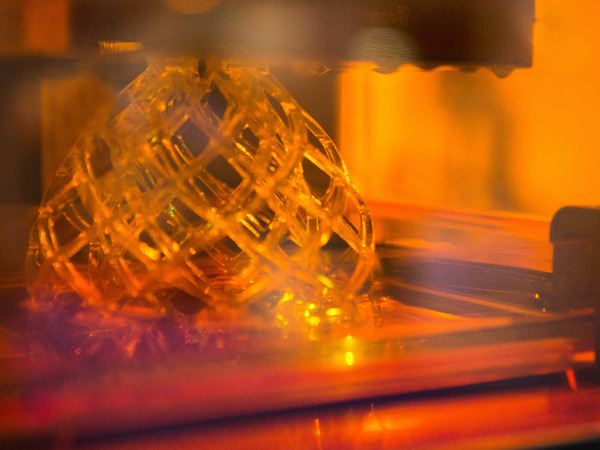
There are many types of AM techniques, and they all have in common the concept of adding or depositing layers of material to create a final object, as opposed to traditional subtractive manufacturing processes that remove material. One AM technique that has achieved commercial success, and is also recognized as the oldest technique, is vat photopolymerization (VPP), which is a liquid-based AM method that uses a light source to solidify a light-curable photopolymer resin to the desired shape, layer by layer. Some of the more popular types of VPP are stereolithography (SLA) and digital light processing (DLP).
VPP allows free-form structures to be quickly and easily produced. Additional benefits include high levels of accuracy and detail, smooth surface finish, and relatively large build area capability. As VPP continues to advance, it will play an important role in raising the standard of current manufacturing.
Vat Polymerization Challenges
Each type of AM technology has a specific set of benefits and challenges. One innate challenge of VPP is a relatively lengthy process time, much of which is due to time-consuming post-processing procedures after the objects have been created. Reducing the time of the photopolymerization step can meaningfully contribute to cutting overall manufacturing time, and the light source chosen for photopolymerization (specifically for SLA, a laser) has a significant influence on speed.
High accuracy and detail may already be benefits of VPP, but the quest to create parts with even tighter accuracy and finer details continues. This is especially true for two-photon polymerization (2PP), a technique based on the same principle of SLA, which can fabricate 3D microstructures suspended inside the liquid or gel without the need for a support structure. Such microstructures can be used in various applications including biomedical, micro-electro-mechanical systems (MEMS) and microfluidics—and typically require nanometerscale resolution. To meet such demanding requirements, 2PP systems must utilize ultrashort laser pulses to selectively cure polymer only at the laser’s focal spot within the material.
Like all manufacturing processes, cost reduction is always a goal. AM is inherently expensive because it lacks the scale of traditional manufacturing and is often utilized for customized designs. And among the various AM technologies, VPP tends to be one of the more expensive processes. In spite of that, there are certain costs that can be controlled and even reduced. For example, components that make up an AM system, including lasers and optics, affect the cost of the entire system, the manufacturing process, and ongoing maintenance. These component costs are a portion of the total, but they add up quickly, particularly for customized designs.
The MKS Advantage for Vat Polymerization
MKS understands the challenges faced in designing and building VPP systems. We’ve turned this knowledge into unique product features that provide an advantage when used in VPP.
Lasers
Fast Q-Switched Lasers
Q-switched lasers with output power ranging from hundreds of milliwatts to a few watts, like the Spectra-Physics® Explorer® One™ series, are a more capable and lower-cost choice than continuous wave (CW) lasers. Q-switched lasers dissipate a fraction of the heat compared to CW lasers, resulting in lower cost of ownership due to reduced cooling requirements.Because SLA is a scanner-based technology for creating very fine structures, the pulse repetition rate of a Q-switched laser should be at least in the tens of kHz. To scan even faster and reduce processing time, lasers with repetition rates of a few hundred kHz should be considered.
The rise time of a Q-switched laser is also important because the system jumps from vector to vector to cure the resin, so the laser power must rise from one pulse to the next very quickly. Explorer One lasers can rise to approximately 90% of maximum power within one to two pulses.
Explorer® One™ Compact Nanosecond Lasers
Explorer® One™ is a compact, diode-pumped solid state (DPSS) ns UV laser which can deliver output power levels from 100 mW to 6 W, thereby covering all SLA requirements ranging from fine structures to larger surface areas. Complementing Explorer One’s power levels is its high dynamic power range which ensures reliable and stable output power from approximately 10% of nominal to full nominal power—this allows a single laser to be utilized in an SLA machine while also providing versatility. Combining these power features with Explorer One’s ns pulse widths, pulse repetition rates from single shot to hundreds of kHz, and typical rise times of ~90% of maximum power within 1 to 2 pulses enables fast SLA scanning. This laser also produces a very close-to-ideal Gaussian beam (M2 < 1.3) with power stability within 2% to ensure consistent high-resolution scans. Units have demonstrated reliable, continuous operation over extended service lifetimes. Explorer One is also the most compact laser in its class, weighing just a few kg, making it easy to integrate into SLA systems.
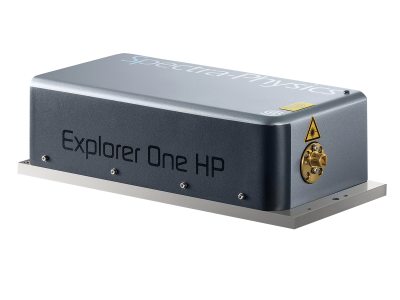
- 100 mW to 6 W power
- High dynamic power range
- Pulse widths <10, 12 or 15 ns
- Typical rise times of ~90% of max power within 1-2 pulses
- M2 < 1.3, TEM00
- Most compact laser in its class
| Explorer One | Explorer One XP | Explorer One HP | |
|---|---|---|---|
| Wavelength | UV | ||
| Power | 800 mW | 2 W | >4 or >6 W |
| Pulse Width | <10 ns | <12 or <15 ns | |
| Repetition Rates | Single shot to 200 kHz | Single shot to 500 kHz | Single shot to 200 or 500kHz |
| M2 | <1.3, TEM00 | ||
| Stability | <2% | ||
| Other Features | Very compact, lightweight air-cooled designs Fast rise times Thousands of hours in the field |
||
High Accuracy UV Lasers
To consistently produce high resolution SLA parts, it follows that high accuracy lasers must be employed. UV lasers are the preferred and essentially sole option because of their curing properties with photopolymers and their ability to deliver very fine beam spots at the curing point.
In addition to the size of the beam diameter, the quality of the laser beam critically affects resolution. A good measure of beam quality is M2, or how much it diverges from an ideal Gaussian beam. Lasers with M2 values closer to one, meaning closer to an ideal Gaussian beam, produce higher resolution components.
Explorer One UV lasers deliver on this with near-ideal Gaussian beams (M2 < 1.3) and beam diameters at the waist below one millimeter.
Compact Femtosecond Lasers
For 2PP additive manufacturing, ultrafast lasers are required. Unlike traditional SLA, which requires UV, 2PP is typically achieved with visible to NIR wavelengths. The Spectra-Physics HighQ-2™ is an ultracompact, fs laser that delivers exceptional results for 2PP. Its high peak power and focusable Gaussian beam profile enable micron- and sub-micron-scale precision. The HighQ-2 is air-cooled and manufactured in a controlled cleanroom environment, providing a turnkey solution built for dependable 24/7 operation and long service life.
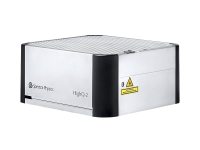
- 522 or 1045 nm wavelengths
- >35 kW (522 nm) or >80kW (1045 nm) peak power
- >0.65 W (522 nm) or >1.5 W (1045 nm) average power
- Pulse width <250 fs • M2 < 1.15, TEM00
- Ultracompact, designed for 24/7 operation
- High uptime and low cost of ownership
| HighQ-2™ | ||
|---|---|---|
| Wavelength | IR | Green |
| Peak Power | >80 kW | >35 kW |
| Average Power | >1.5 W | >0.65 W |
| Pulse Width | <250 fs | |
| Repetition Rates | 63 MHz | |
| M2 | <1.15, TEM00 | |
| Power Stability | <1% rms (100 hours) <0.5% rms (12 hours) |
|
| Other Features | Ultra-compact Air-cooled High uptime Low cost of ownership |
|
Optics
For the vat polymerization lasers required, you will likely be operating around 355 nm UV. Both broadband and laser line optics are available, but because you know your target wavelength in advance, laser line optics are the better choice — optimized for a single wavelength, they deliver higher performance than broadband alternatives.
Custom Optics and Integrated Assemblies
The laser beam of an SLA process must also be shaped, steered, focused and otherwise managed quickly. This is achieved with an intricate system of lenses, mirrors, other optics, opto-mechanical components, and sometimes motorized positioning. Newport's experienced team of lens designers, opto-mechanical engineers, and physicists specializing in custom optical design and development can deliver complete integrated solutions that shape beams and rapidly adjust focus and spot size for SLA applications.
SLA typically uses UV wavelengths, such as 355 nm, and Newport specializes in designing thin-film reflective, anti-reflective, partially reflective, and high-power coatings for laser optics down to 193 nm. MKS can manage build-to-print and build-tospecs or can design a custom solution to meet your application’s requirements. And with our world-class manufacturing capabilities, MKS is able to scale quantities as needed and also provide cost-effective high-volume production.
High-Energy Laser Optics
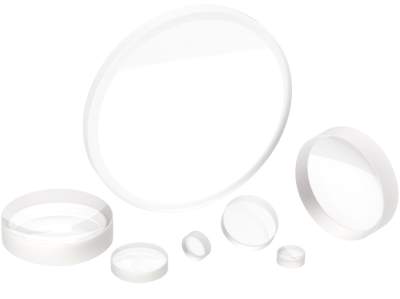
Dozens of Newport standard catalog optics are designed to operate with high-energy lasers, including those used in stereolithography (SLA) applications. Mirrors, lenses, beam splitter cubes and waveplates are readily available in various sizes and shapes whose substrate materials and coatings are optimized for UV wavelengths. These high-performance optics withstand demanding laser fluences across a wide range of stereolithography applications.
- Mirrors
- Lenses
- Beam Splitter Cubes
- Waveplates
- Optimized for UV wavelengths
- Extensive ultrafast optics selection
- LIDT (Laser Induced Damage Threshold) of up to 45 Joules per cm2
Complex Optics & Optical Assemblies
MKS has an experienced team of lens designers, opto-mechanical engineers, and physicists specializing in optical design and development. We are more than just a supplier of optical components – MKS can be your partner to deliver optical solutions for your needs. We can provide high precision optical assemblies, for example, lens assemblies. We can also build complete integrated solutions of optics, opto-mechanics and electronics, such as a system to shape beams and quickly change focus and spot size.
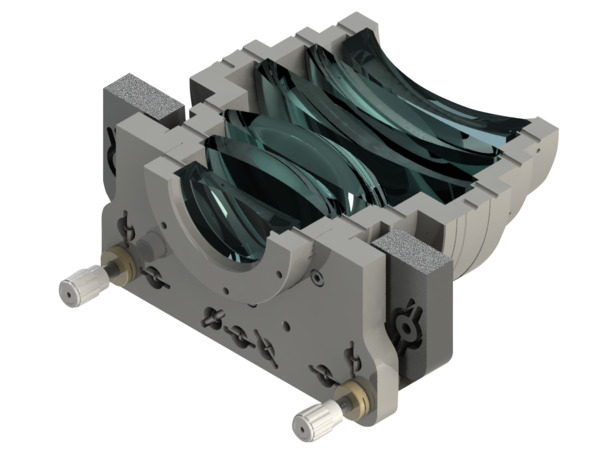
A common device used to steer SLA lasers very quickly is a galvanometer scanner, or galvo. Although galvos can produce steering speeds of up to several meters per second with sharp corners, they have a limited field of view (FOV), on the order of 100-200 mm, and a limited focal spot size of around 10-20 microns. By contrast, motorized linear positioners provide for a large FOV and allow for tight focal spots. Combining galvos and motorized positioners in a SLA system—by having positioners move the target or move the galvos—can take advantage of each of their features. Newport offers a full range of motorized positioners and motion controllers that can synchronize the motion of galvos and positioners for high accuracy, precision, and speed.
Opto-Mechanics
When optics are part of a laser system, they must be precisely positioned and held stable over long periods of time. Newport offers one of the broadest lines of opto-mechanical components available. Hundreds of Newport optical mounts and positioners at various levels of performance and cost are readily available.

- Mirror mounts, lens positioners and other optical mounts
- Linear and rotary positioners
- Post and pedestal assemblies
- Stainless steel and aluminum
Laser Beam Analysis
Laser systems can degrade over time, leading to a reduction in output power or a shift in focus, which can result in inaccurate or inefficient polymerization. Some causes of degradation include the laser’s thermal energy affecting optics, debris at the processing site, vibration and shock. For this reason, laser beam parameters should be monitored frequently and verified before each critical step in the laser manufacturing process. Newport offers a full range of Ophir® instruments for beam characterization across any wavelength, power level, and beam diameter.
- Laser power and energy sensors measuring up to hundreds of kilowatts and hundreds of joules
- The most precisely calibrated power meters on the market
- Scanning slit and camera-based beam profilers to determine focus position, spot size and M2
Beam Profiling Cameras
Camera-based systems are one of the most reliable ways to analyze a laser's beam profile. Ophir beam profiling cameras allow real-time viewing and measuring of a laser’s structure in high resolution. Camera-based systems can also measure cross-sectional intensity of the laser and provide a complete 2-dimensional view of the laser mode.

- Spectral ranges from UV to mid-IR
- High-resolution, real-time viewing
- Highest accuracy measurements
- User-friendly application software with extensive analytical features included
Motion Control
A common device used to steer SLA lasers very quickly is a galvanometer scanner, or galvo. Although galvos can produce steering speeds of up to several meters per second with sharp corners, they have a limited field of view (FOV), on the order for 100-200 mm, and limited focal spot size of around 10-20 microns. By contrast, motorized linear positioners provide for a large FOV and allow for tight focal spots. Combining galvos and motorized positioners in a SLA system—by having positioners move the target or move the galvos—can take advantage of each of their features. MKS offers not only a full range of Newport™ motorized positioners but also Newport motion controllers that can synchronize the motion of galvos and positioners for high accuracy, precision and speed.
Ultra-Precision Linear Motor Stages
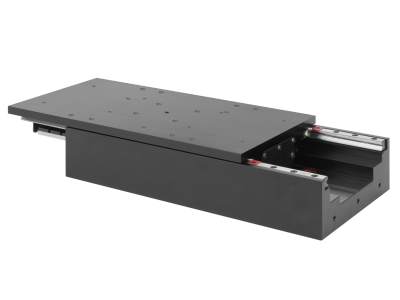
The Newport XM Series is a high-performance series of linear positioners for stereolithography (SLA). They feature an ironless linear motor and crossed-roller bearings for smooth motion, sub-micron accuracy, and repeatable positioning. With minimum incremental motion as small as 1 nm, they are especially well suited for two-photon polymerization (2PP). Several models with various dimensions and travel ranges are available for the most demanding positioning requirements in high volume SLA production.
| XM-S Series | |
|---|---|
| Travel Range | 50 to 350 mm |
| Minimum Incremental Motion | 1 nm |
| Speed | 300 mm/s |
| Load Capacity | 100 to 300 N |
| Accuracy | ±0.2 to ±0.5 µm |
| Repeatability | ±0.03 to ±0.035 µm |
| Straightness & Flatness | ±0.37 to ±0.75 µrad |
| Other Features | Ironless Linear Motor Crossed-roller bearings |
Motion Controllers
Newport’s high-performance XPS-D series of motion controllers can control up to 8 axes of motion and offers movements ranging from basic to complex position-velocity-time, or PVT, motion trajectories through high-speed Ethernet TCP/IP interface. Its analog and digital I/O allow it to monitor and synchronize with external events, including galvos and motorized positioners for additive manufacturing (AM).
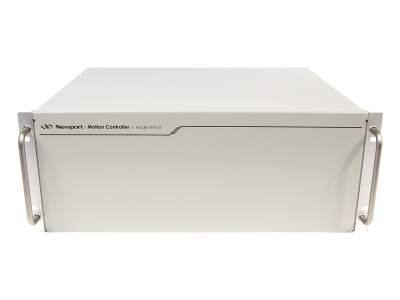 XPS-D |
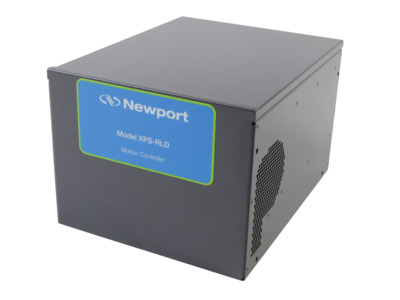 XPS-RLD |
|---|---|
|
|
Vibration Control

To improve SLA system performance, platforms may be mounted with vibration isolation. As the leader in vibration control and isolation, Newport offers elastomer and pneumatic isolators that can be built into equipment isolation supports and custom machinery feet. Standard catalog products cover a wide range of applications, or Newport can work with you to understand your machinery characteristics, including load, shock response, and resonance modes, to design a custom solution. Orders can be scaled to meet volume requirements through Newport's manufacturing capabilities.
Resources
Transforming VAT Polymerization AM Brochure(6.3 MB, PDF)