Sorry, this family of products is no longer available.
Laser Beam Profilers
Laser Beam Profilers
LBP2 series laser beam profilers and accessories have been discontinued. Please see the replacement products in table below.
- Windows 10 and USB 3.0 compatible cameras
- Extensive set of ISO 11145, 11146-1/-3, and 13694 measurements
- Patented Ultracal™ algorithm for highest accuracy measurements
- Pass/fail testing available on most measured parameters
- Statistical Analysis of all measured parameters
- Industry standard data file formats, HDF5 and CSV See All Features
Features
Non-Gaussian Beam Profiles
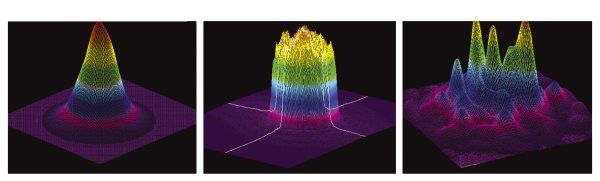
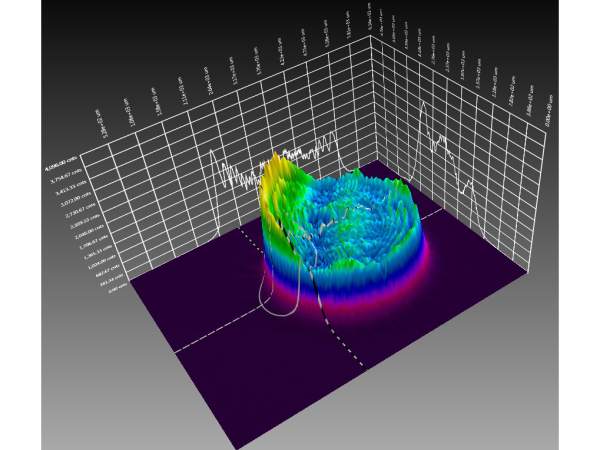
While many laser systems operate with near-Gaussian beams, other laser systems possess non-Gaussian beams that propagate differently and exhibit significantly different spatial distributions (see above figure for examples). In some cases, a laser resonator emits a beam with a higher-order TEMmn mode. Depending on the resonator geometry, these modes can be cylindrical in nature and are called Laguerre-Gaussian beams or rectangular and are called Hermite-Gaussian beams. In other cases, a laser beam is modified by an optical system to such an extent that its profile and propagation can no longer be approximated using the Gaussian beam analysis. Flat-top beams are one such example where a beam exhibits a nearly constant irradiance over its beam width. Given the steep edges of the beam profile, the diameters of these beams are often characterized by their full-width at half-maximum (FWHM) values as opposed to the HW1/e2 radius values used for Gaussian beams. Such flat-top beams are important for laser-based material processing where a constant irradiance provides more uniform material modification. The propagation of these beams can be quite complicated and is often encountered when a laser beam overfills a focusing objective in order to generate a very small spot size in high-resolution microscopy.
Right High Quality Camera for Various Applications
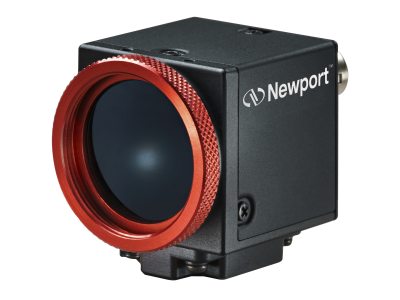
The new LBP2 series laser beam profilers are available with a visible (190 - 1100 nm) CCD or a phosphor coated (1440 - 1605 nm) CCD camera. Both the cameras feature high resolution 1624 x 1224 array. In order to minimize interference and provide the most accurate laser beam profile, the protective window is removed and the cameras are shipped with an ND filter and a protective cap premounted on them.
Stackable Attenuators for High Power Input
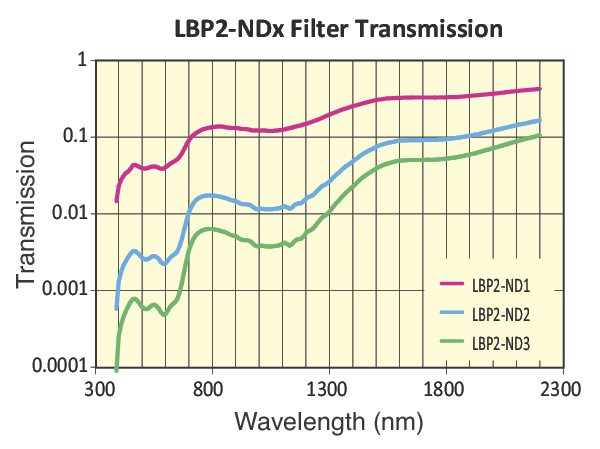
Each laser beam profiler comes with stackable neutral density filters (one ND1 and two ND2 filters) with a 19 mm clear aperture, 1 inch-32UN (C-Mount). They are used to protect the camera by attenuating the beam and to help the camera measure the beam size accurately by keeping the intensity level below saturation. The damage threshold for these ND filters is 50 W/cm2, however, distortion due to thermal lensing can happen at as low as 5 W/cm2. These filters are also separately available for purchase as
Easy Software and Camera Installation
Extensive Software Features
UV Beam Imager
The new
UV Beam Splitter
The new
Phosphor Coating Optimized for 1440 - 1605 nm
The Phosphor coating technology allows you to view NIR (1440 - 1605 nm) lasers and light sources to measure with LBP2-IR and LBP2-HR-IR . The anti-Stokes phosphor coating produces visible photons at a rate roughly the square of the input signal. This non-linearity or Gamma is corrected in the software's Gamma Correction function. Thus an accurate, linear image of the beam profile is obtained permitting standard, cost effective analysis of NIR beams. Note that the measured laser spot size will be slightly larger than the actual size, due to the use of phosphorescence.
Recertification
Unlike an optical power meter or a detector, a laser beam profiler does not have any recalibration process, as there is no traceable standard. However, to help you maintain camera performance, we recommend that customers return their camera on a regular basis (every 12 months is recommended under normal use) for a verification and recertification process. This process will correct bad pixels when possible, clean the imager, and certify that your camera is still performing to factory specifications. Or you will be advised of any changes that may be serious enough to require limiting use, repair or replacement. Please contact Newport calibration facility for inquiry and service.
Replacement Products for LBP2 Series Beam Profilers and Samplers
| Part Number | Description | Replacement |
|---|---|---|
| LBP2-HR-VIS3 | Beam Profiler, 190-1100 nm | SP90608 |
| LBP2-HR-IR3 | Beam Profiler, 1440-1605 nm | SP90563 |
| LBP2-SAM-BB2 | Beam Sampler, 190-1550 nm | SP90467 |
| LBP2-SAM-UV2 | Beam Sampler, 266-355 nm | SP90464 |
| LBP2-SAM-VIS2 | Beam Sampler, 400-700 nm | SP90465 |
| LBP2-SAM-NIR2 | Beam Sampler, 1064 nm | SP90466 |
| LBP2-ND1 | ND1 Attenuator | SPZ08234 |
| LBP2-ND2 | ND2 Attenuator | SPZ08235 |
| LBP2-ND3 | ND3 Attenuator | SPZ08253 |
| LBP2-UVBS | UV Beam Splitter | SPZ17015 |
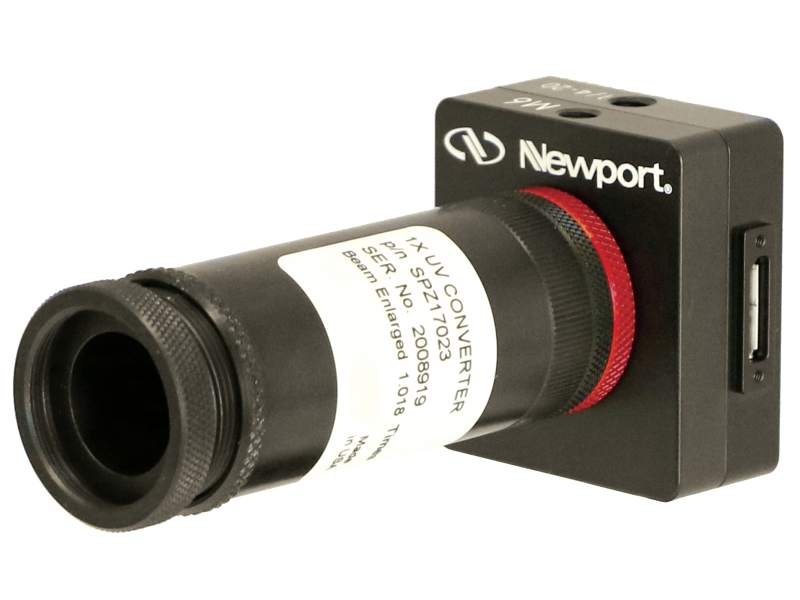
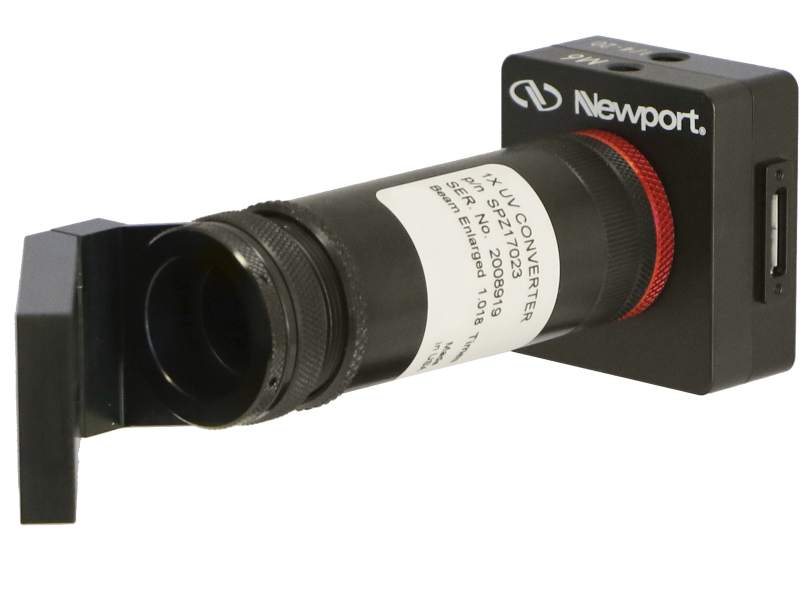
| LBP2-UVIMG | 1X UV Image Converter | SPZ17023 |
Accessories
Beam Samplers
The beam sampler operates by reflecting the incoming beam from the front surfaces of a pair of wedges through 90 degrees into the camera. Approximately 99% of the beam is transmitted through the beam sampler with 0.01% passed on to the camera.
ND Filters for Laser Beam Profiler
Additional stackable ND filters with a 19 mm clear aperture are shown below.
UV Beam Viewing Accessories
Resources
Software
LBP2 Software Features.pdf(59.8 kB, PDF) LBP2 Series Rev 3.4.0 Software(500.3 MB, ZIP) ReadMe LBP2 Series.pdf(130.1 kB, PDF)
Manuals
LBP2 Laser Beam Profilers User Manual(4.1 MB, X USER GUIDE)
Literature
Telecom Data Brochure(4.9 MB, PDF) Laser Beam Profiler White Paper(476.4 kB, PDF) LBP2 Serial Laser Beam Profiler Datasheet(1.2 MB, PDF)