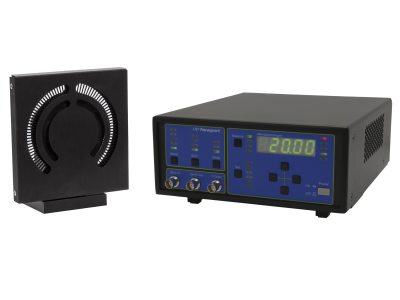
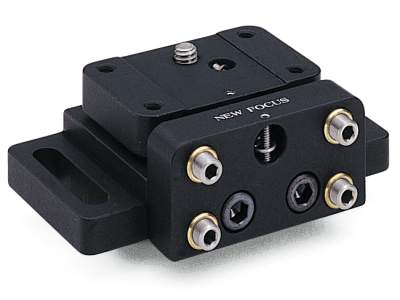
Sorry, this family of products is no longer available.
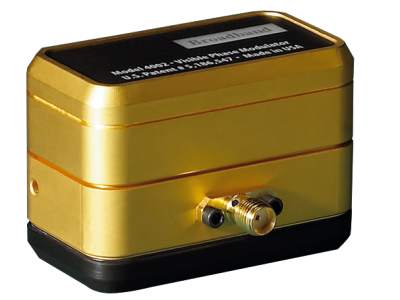
Electro-Optic Phase Modulator
Electro-Optic Phase Modulator
New Focus standard phase modulators are available in a wide variety of wavelength ranges, operating frequencies, and in broadband or resonant models, ensuring we have an ideal solution for your application needs including atomic physics, laser-frequency stabilization, and high-resolution spectroscopy.
- Large operating frequency range coverage
- Resonant designs offer very low drive voltages
- Wide wavelength coverage
- Mechanical apertures for easy optical alignment See All Features
Specifications
Features
Large Operating Frequency Range Coverage
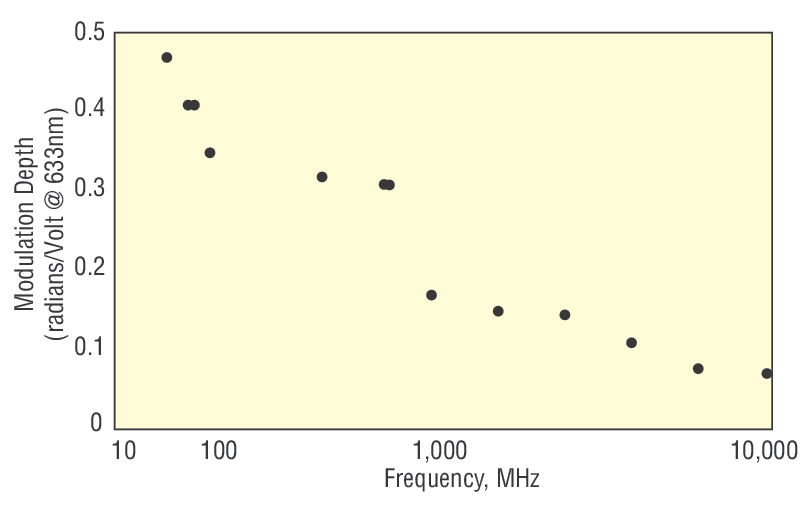
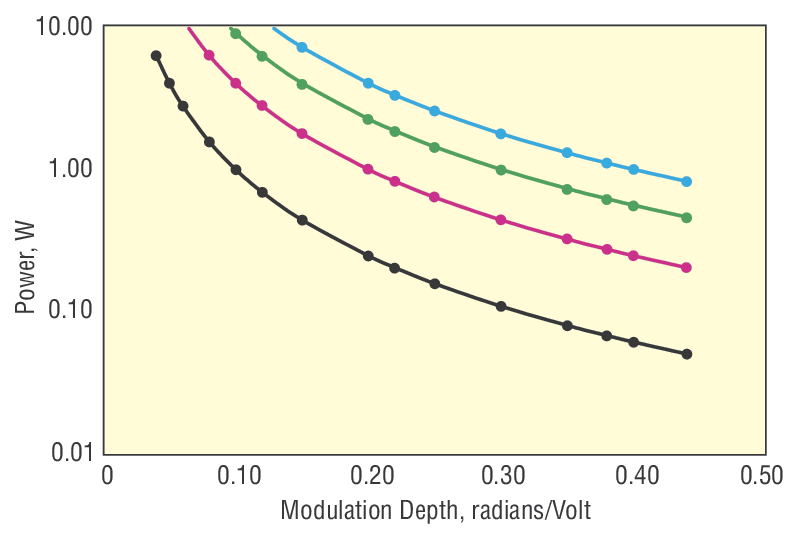
Resonant Designs Offer Very Low Drive Voltages
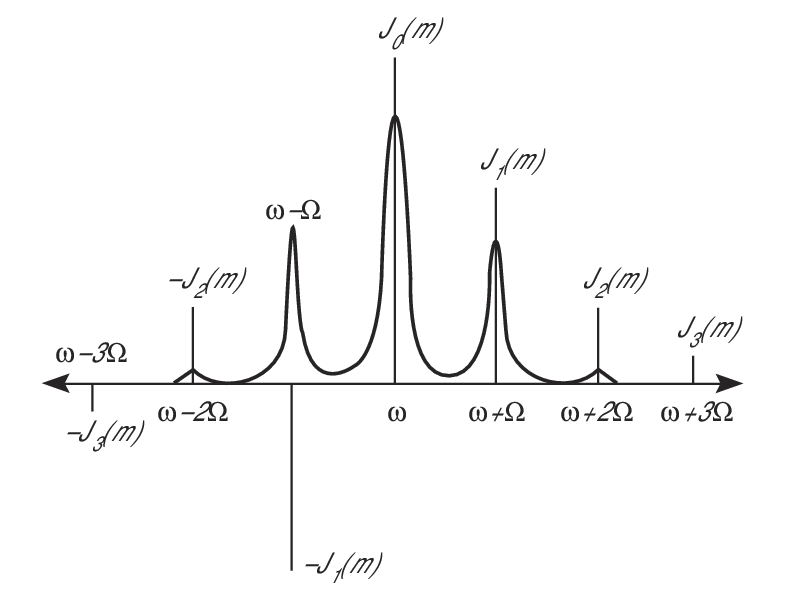
Phase Modulator Bessel Functions
This spectrum of a phase-modulated electric field is given by Bessel functions. The optical intensity of each sideband is proportional to the square of the electric field amplitude. The amplitude of the kth sideband is proportional to Jk(m), where Jk is the Bessel function of order k. The fraction of optical power transferred into each of the first-order sidebands is [J1(m)]2, and the fraction of optical power that remains in the carrier is [J0(m)]2.
Phase Modulator Operation
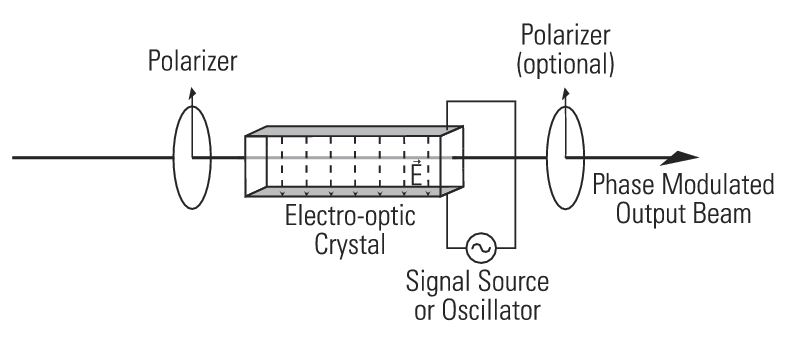
When a phase modulator is used, the laser beam should be well collimated and its polarization should be oriented vertically to within 1°. For an unpolarized laser, the polarizer should have an extinction ratio greater than 100:1. We recommend our Glan-Thompson polarizers or our low-cost sheet polarizers.
Mechanical Apertures for Easy Optical Alignment
Move Your Optical Isolator Instead of the Beam
Our multi-axis stages are designed for applications where precise positioning and high stability are required. Shown here is a typical application of aligning an optical modulator to a laser beam with our four-axis kinematic device alignment stage.
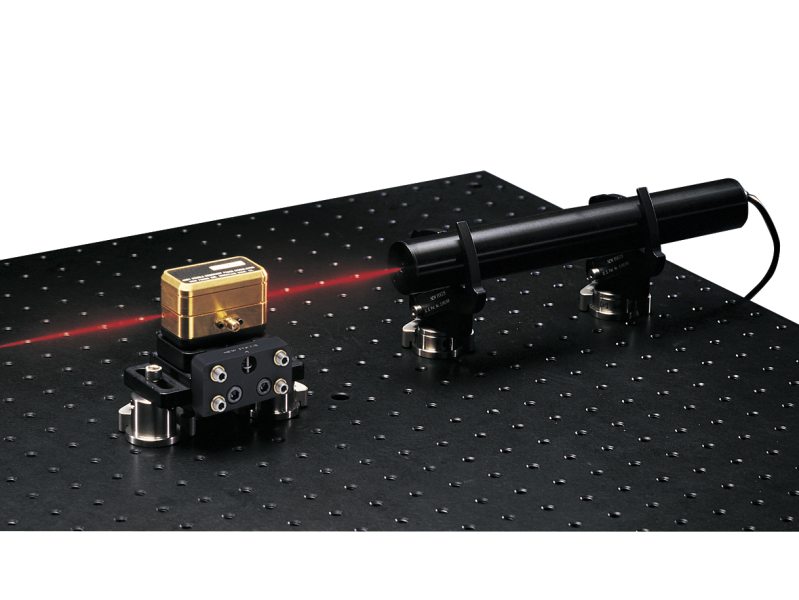
Observing Phase Modulation
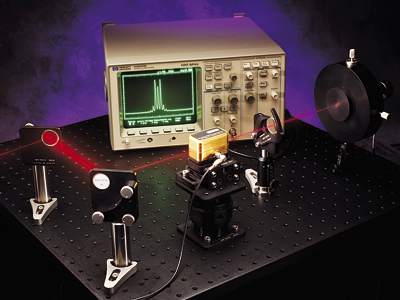
A typical setup for observing phase modulation: a HeNe laser beam is sent through a Model 4001 resonant phase modulator operating at 29 MHz, and the beam is focused into an optical spectrum analyzer. The laser’s phase-modulated spectrum, with its characteristic frequency sidebands, is observed on an oscilloscope.
Laser Frequency Stabilization Application
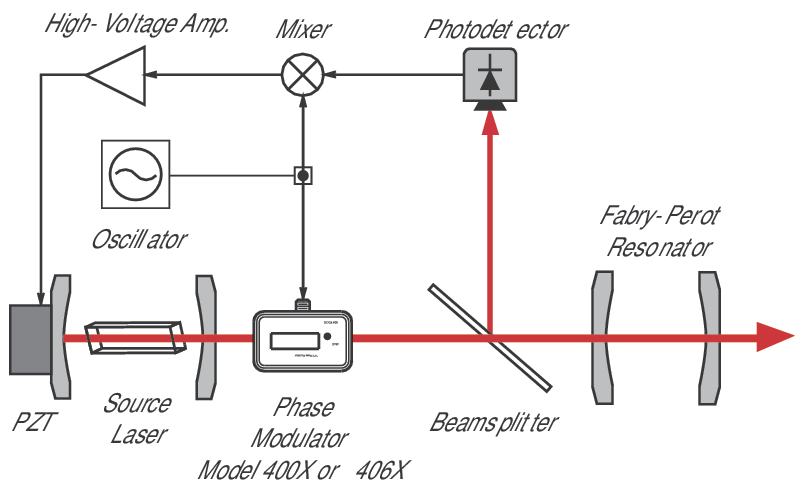
A Model 4001/3 or 4061/3 resonant phase modulator is the ideal component to use in a Pound-Drever-Hall laser frequency stabilization system. This optical FM frequency discriminator technique* is used to lock the optical frequency of a laser to a stable Fabry-Perot reference cavity. The system consists of a single-frequency laser beam that is sinusoidally phase modulated and coupled into an axial mode of the Fabry-Perot resonator cavity. The stabilization signal is fed back to a high-voltage amplifier that drives a piezoelectric transducer (PZT). The frequency-stabilized light transmitted by the cavity is clean spatially as well as spectrally. *R.W.P. Drever, et al. “Laser Phase and Frequency Stabilization Using an Optical Resonator,” Appl. Phys. B31, pp. 97–105 (1983).
Accessories
Kinematic Alignment Stages
| Compare | Description | Drawings, CAD & Specs | Avail. | Price | ||
|---|---|---|---|---|---|---|
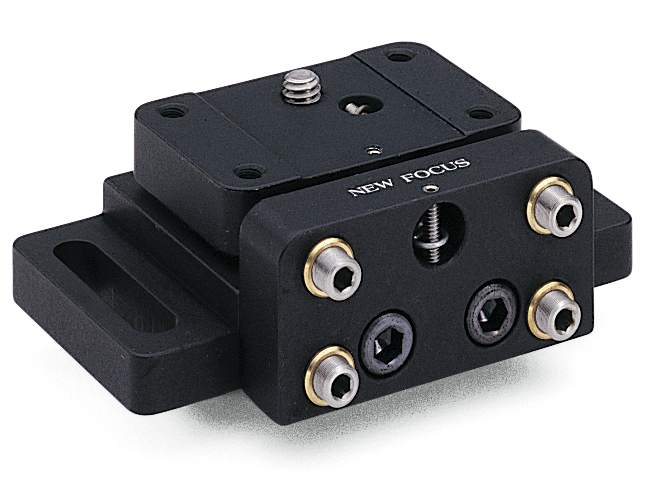 | 9071Device Alignment Stage, Four-Axis, 3 mm Linear, 8° Angular, 8-32 & 1/4-20 | In Stock FREE 2-day shipping on thousands of products on Newport.com Learn More | ||||
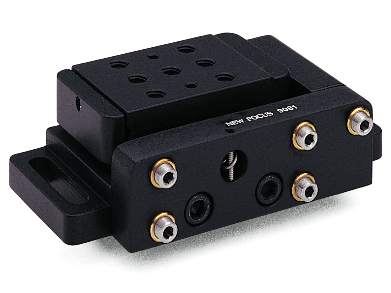 | 9081Device Alignment Stage, Five-Axis, 3 mm Linear, 8° Angular, 8-32 & 1/4-20 | In Stock FREE 2-day shipping on thousands of products on Newport.com Learn More | ||||
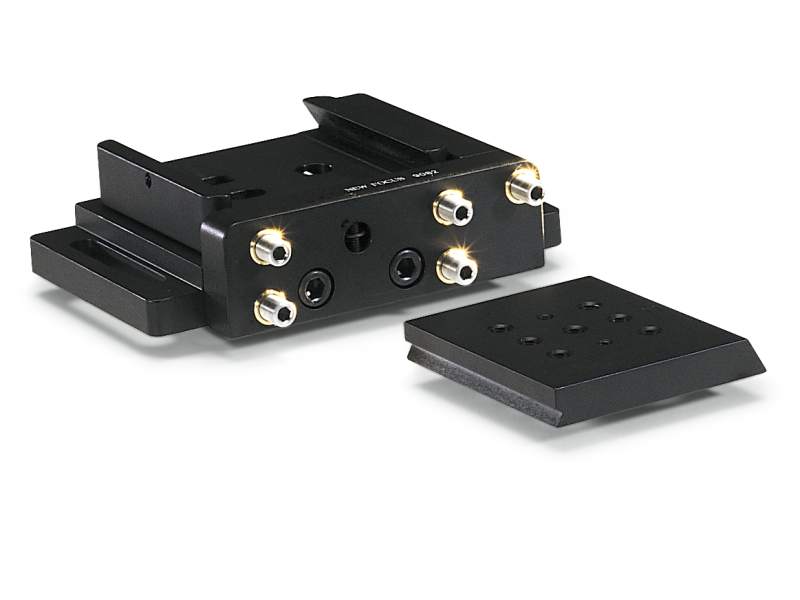 | 9082Device Alignment Stage, Wide, Five-Axis, 3 mm Linear, 8° Angular, 8-32 & 1/4-20 | FREE 2-day shipping on thousands of products on Newport.com Learn More |

Broadband Modulator Driver
Resources
Manuals
400X and 406X Phase Modulators User Manual(893 kB, PDF)