
Silicon Photonics: Powering the Next Generation of Data Centers
The rapid advancement of artificial intelligence (AI) is driving an unprecedented build-out of data centers. These facilities are required to deliver the immense computing power needed for training and running large language models with hundreds of trillions of parameters. To satisfy this growing demand, the underlying hardware within data centers-including routers, switches, servers, and interconnection devices must be continuously upgraded to enhance network capacity. Among these, optical interconnection devices, mainly optical transceiver modules, have become critically important for achieving higher computing performance. Consequently, the demand for higher-speed optical transceiver modules is exploding, with development rapidly progressing from 400G to 800G and now 1.6T and beyond.
The Shift to Transceivers Based on Silicon Photonics (SiPh)
Optical transceiver modules are essential interconnection devices that convert electrical signals into optical signals for information transmission over fiber optic cables to other racks or systems. Traditional pluggable optical modules are assembled from discrete optical components, such as laser diodes, modulators, and photodiodes as well as waveguide, which are precisely aligned and packaged together. The performance and cost of these modules are heavily dependent on this complex and precise packaging process.
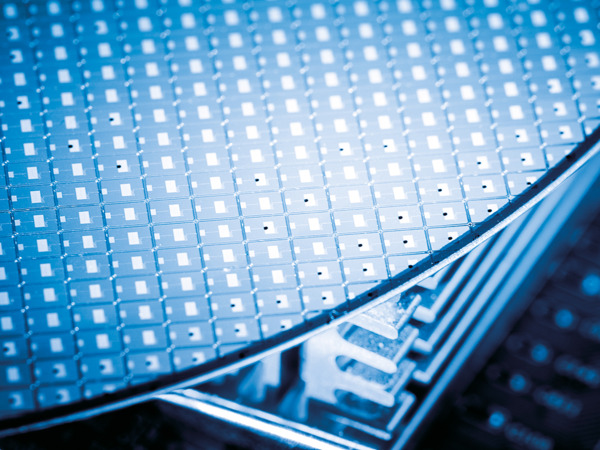
The technological roadmap for higher speed is now pointing toward silicon photonics-based transceivers. This technology leverages mature Complementary Metal-Oxide-Semiconductor (CMOS) fabrication process, but instead of building transistor, it creates waveguide and other optical devices on a silicon-on insulator (SOI) wafer. This approach enables monolithic integration, where components like modulators, waveguides, and photodiodes are fabricated onto a single chip, often with the laser source hybrid integrated. Compared to traditional transceiver technology, silicon photonics (SiPh) offer several key advantages:
- Low Cost: Leverage high-volume semiconductor manufacturing reduces assembly and packaging costs.
- Lower Power Consumption: Integrated optical devices are typically more energy efficient.
- Higher Bandwidth: Enable the dense integration required for 800G, 1.6T and future date rates.
- Lower Latency: More efficient on-chip and chip-to-chip optical links.
Currently, SiPh has already been employed in 800G and 1.6T pluggable transceivers, in which SiPh-based Mach-Zehnder modulators are mostly employed. As the industry looks ahead to 3.2T transceivers and Co-Package Optics (CPO), where optical engines are placed alongside the switch ASIC in the same package, SiPh is poised for even broader adoption. Especially for CPO, SiPh-based micro-ring modulators are often the preferred component due to their ultra-compact size and low power consumption, further underscoring the necessity of SiPh technology.
Critical Manufacturing Application Enabled by Precision Tools
The transition to SiPh-based supply chain, resembling semiconductor manufacturing, introduces two critical production challenges:
- SiPh Wafer-Level Probing and Testing: Before a wafer is diced into individual chips, thousands of discrete optical devices must be probed and tested for performance metrics such as insertion loss and coupling efficiency. This requires vertical coupling between a fiber array and diffractive grating couplers on the wafer. The process demands a motion control system capable of automated alignment with sub-micron accuracy, guided by sophisticated algorithms to rapidly locate the point of maximum coupling efficiency-a prerequisite for high yield and cost control.
- High-precision Fiber Alignment for Advanced Packaging: Edge coupling, which aligns optical fiber to on-chip waveguides, is another critical step. Achieving the necessary sub-micron accuracy typically requires active alignment, where the optical signal is monitored in real-time to find and lock the position of peak efficiency before permanent attachment with UV-curable epoxy. While single-channel alignment is mature, SiPh’s complexity, requiring simultaneous alignment of fiber arrays to multiple channels, demands more advanced systems and algorithms to meet the accuracy and throughput requirements of high-volume production.
MKS’s Strategic Advantage in the SiPh Ecosystem
The adoption of SiPh technology has fundamentally reshaped the transceiver supply chain, shifting the focus from discrete assembly to a process more akin to semiconductor manufacturing: Front-end process steps comprising of IC design, SiPh wafer fabrication, wafer probing and testing following by back-end process steps of advanced packaging and final test & assembly.
During wafer manufacturing, wafer-level testing is essential to measure and validate the performance of optical components before dicing and packaging. This is critical step for ensuring yield and controlling costs.
MKS is uniquely positioned to support this entire ecosystem. With a comprehensive portfolio that includes laser for wafer dicing, power supplies for etching and deposition, and precision motion control for alignment and testing, MKS provides the foundational tools that enable the high-volume production of silicon photonics devices. This expertise in both photonics and vacuum/industrial markets gives us a distinct advantage in supplying the critical technologies needed to manufacture these advanced chips.
Integrated Solution for SiPh Manufacturing
Motion Control and Alignment
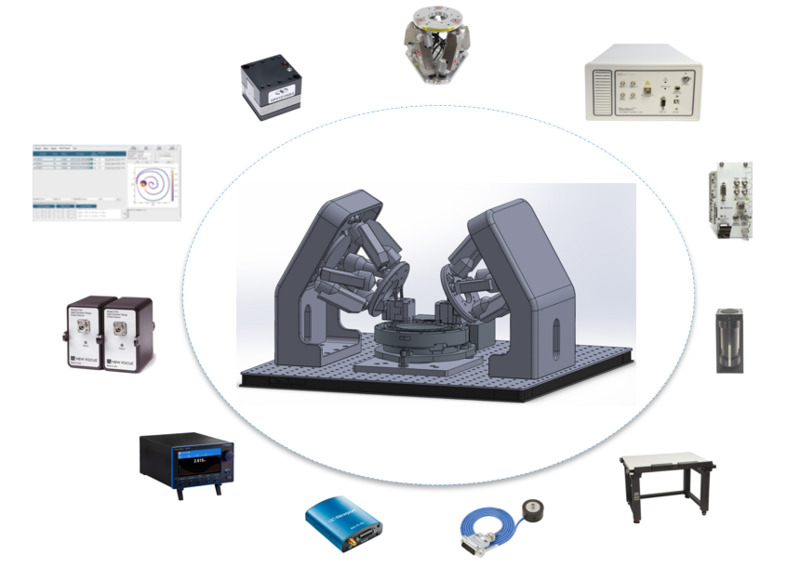
Wafer-level testing of SiPh normally includes coarse alignment between fiber array and multi-channel diffractive grating on SiPh wafer across 6 degrees of freedom (6DOF), followed by precise alignment in sub-micron accuracy. But this coupling procedure is exceptionally challenging, especially for sub-micron or even nanometer scale accuracy and precision, and this precise level of operation must also be executed very quickly, with automatic alignment time <1s, realizing high throughput.
To address these demands of fiber alignment and testing on SiPh wafer level, MKS developed high precision hexapods, offering an effiecient solution to complex, multi-axis motion in a compact construction. It can finish the coarse alignment between fiber array and multi-channel diffractive grating using by providing six degrees of freedom: X, Y, Z, pitch, roll and yaw.
The Hexapod Advantage:
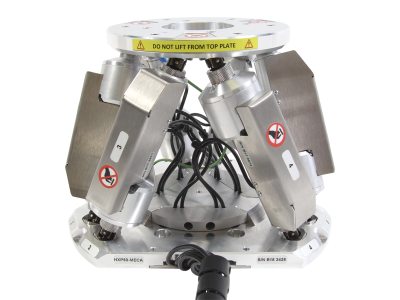
- Single device with 6 independent axes of motion
- Light and compact design, with high stiffness
- No moving cables
- Right path trajectory control
- Two virtual centers of rotation set by software
- HexaViz simulation software
Piezo Stages for Fast and Precise Coupling
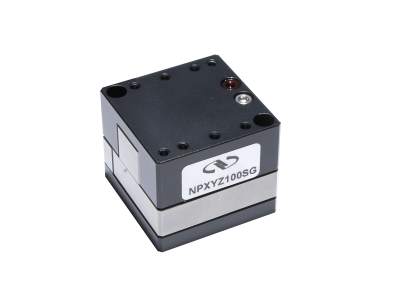
Following coarse alignment, the piezo stage enables fast and precise coupling. NPX piezo stack linear stages provide long travel and sub-nanometer resolution motion in multiple axes, all within a compact package. Both the NPX piezo stage and our Hexapods can be integrated and controlled by a single, unified motion controller.
Algorithm for SiPh
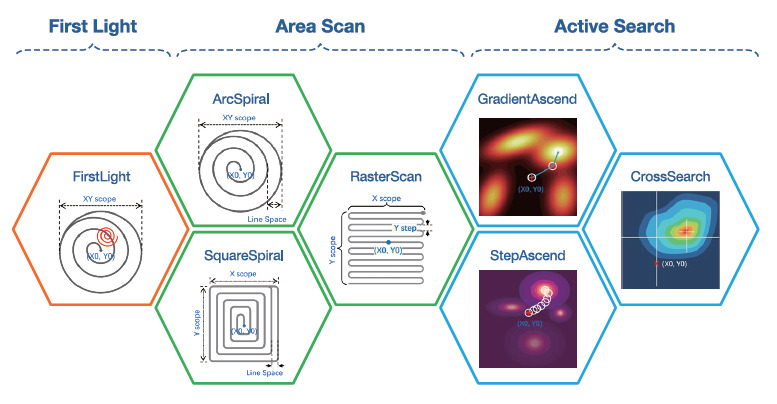
Searching efficiency is one of the most crucial factors in photonics alignment applications, which is specifically true to Si Photonics applications, due to the large quantity of chips to be tested. Searching algorithm plays a crucial role in achieving high searching efficiency, with high alignment accuracy at end of the searching.
MKS provides three categories of search algorithms to address those challenges. It is composed of three categories, including seven algorithms to perform efficient searching. Aside, versatile software GUI provides an effortless way to explore those algorithms, play with different parameters and algorithm combinations, to obtain most optimal configurations for searching.
Light Analysis
To realize the closed-loop control for fiber alignment, the motion system must also integrate power sensors to monitor the coupling signal in real time during the scanning trajectory and record these trajectories to locate the point of maximum coupling.
High analogue bandwidth and high dynamic power range are necessary for quick response in broad power ranging during fiber alignment. Based on these requirements, MKS offers industry leading tools for monitoring and measuring power. The 2940-R high-performance optical power meter, has been extensively employed in fiber alignment because of its excellent analogue bandwidth paired with low noise level. Several power scales were designed in this benchtop power meter for realizing high dynamic power range, and its features are beneficial for fiber alignment.
Benchtop Optical Power Meter Advantage:
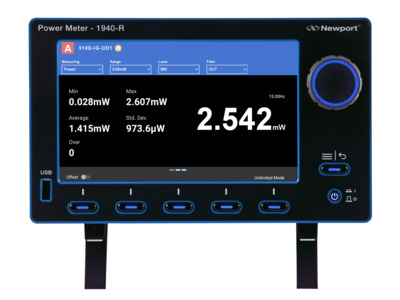
- Optimized for R&D, production and fiber alignment
- NIST-traceable with ISO/IEC 17025 accreditation
- Time-stamped data acquisition at up to 10 kHz
- Compatible with a wide range of Newport sensors
- Intuitive knob-and-button interface with 7 in. touchscreen display
- Automation-ready USB, Ethernet, RS232 and trigger I/O
For higher requirement of alignment time, our 2103 high dynamic range power sensor offers extremely low latency between power range switching, allowing to fast real-time monitor and record the coupling signals. That feature of seamless gain switching is especially important for SiPh wafer-level testing, where thousands of dies are distributed on a wafer before dicing and need to be tested with high-volume throughput in a short time.
High Dynamic Range Power Sensor Advantage:
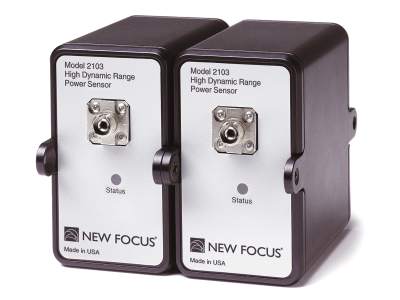
- Automatic seamless gain switching ensures high dynamic range
- Logarithmic analog output spanning 70 dB
- Modular design to conveniently build optical systems
- Up to 25 kHz bandwidth
MKS also provides various kinds of power sensors, including standard photodiode power sensors and modular integrating sphere sensors with measurable power ranging from 20 pW to 8 W, and wavelengths ranging from 200 nm to 1650 nm.
Tunable Laser Sources
Wavelengths of optical fiber communication include O-, E-, S-, C-, and U- as well as 850 nm band. During the SiPh wafer-level testing, measuring optical insertion loss and coupling efficiency as function of wavelengths are necessary for special designed optical components.
The Venturi™ TLB-8800 swept-wavelength lasers can deliver all relevant telecommunication wavelength range, which combine the best in tunability – ultrafast, ultrawide, and mode-hop-free – with low noise, high accuracy, and repeatability, making them very suitable for SiPh testing. With our benchtop power meter, using sync output function, the TLB-8800 series laser can provide spectral measurement with high resolution and high accuracy.
Venturi™ TLB-8800 Swept-wavelength Lasers Advantage:

- Up to 20,000 nm/s wavelength tuning
- Swept and step tuning modes
- Programmable high frequency repetition rates
- Programmable coherence control
- Continuous wave and single longitudinal mode
Vibration Control
Vertical coupling on wafer-level and edge coupling on single die-level after wafer dicing are vibration sensitive, where any vibration can cause inaccuracy and low yield of measurements. To minimize this impact, MKS provides a series of vibration control systems, including optical tables and vibration isolator tables. As a common base, optical tables can serve whole motion stages, and any vibration from motion stage can be damped by optical table itself. Vibration isolators can isolate vibration from surrounding environment.
With more than 60 years of extensive experience in vibration control solutions and systems, MKS have been leading the industry standards and helped in various applications to achieve outstanding vibration control and isolation results. For example, our Vision IsoStation™ optical workstations with pneumatic isolation possesses both damping and isolation features, where the damping feature can be designed to improve setting time.
Vision IsoStation™ Optical Workstations with Pneumatic Isolation Advantage:
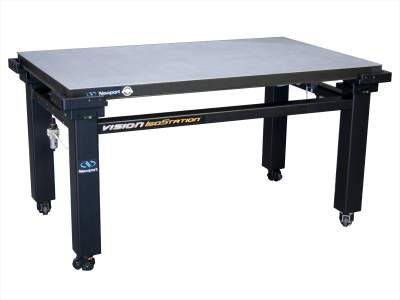
- Precision grade modal damped optical breadboard
- I-325 pneumatic isolators with 1300 lbs. gross load capacity
- More legroom with hip guard and arm rests for seated users
- Shipped fully assembled. Rolls off crate for easy installation
- Integrated bubble levels, seismic restraints & float height
- Wide variety of accessories to customize your workstation